Smart Gateway

Simplify device onboarding and improve field reliability.

P

Overview

The Smart Gateway serves as the on-site access foundation for Power Grid IoT. It supports multi-protocol connectivity, data preprocessing and edge automation for substations, switching stations, distribution rooms, PV/storage and more. With local buffering and resume-on-reconnect, it keeps data complete and services continuous even under weak or disconnected networks—improving integration efficiency and O&M reliability.

Pain Points & Benefits

Complex integration

Unified ingestion and configuration templates shorten on-site commissioning.

Unstable networks

Local buffering + resume-on-reconnect keeps operations stable on weak networks.

Noisy data

Edge preprocessing and filtering reduce cloud compute and bandwidth costs.

Slow automation

Local rules and triggers deliver critical alarms faster.
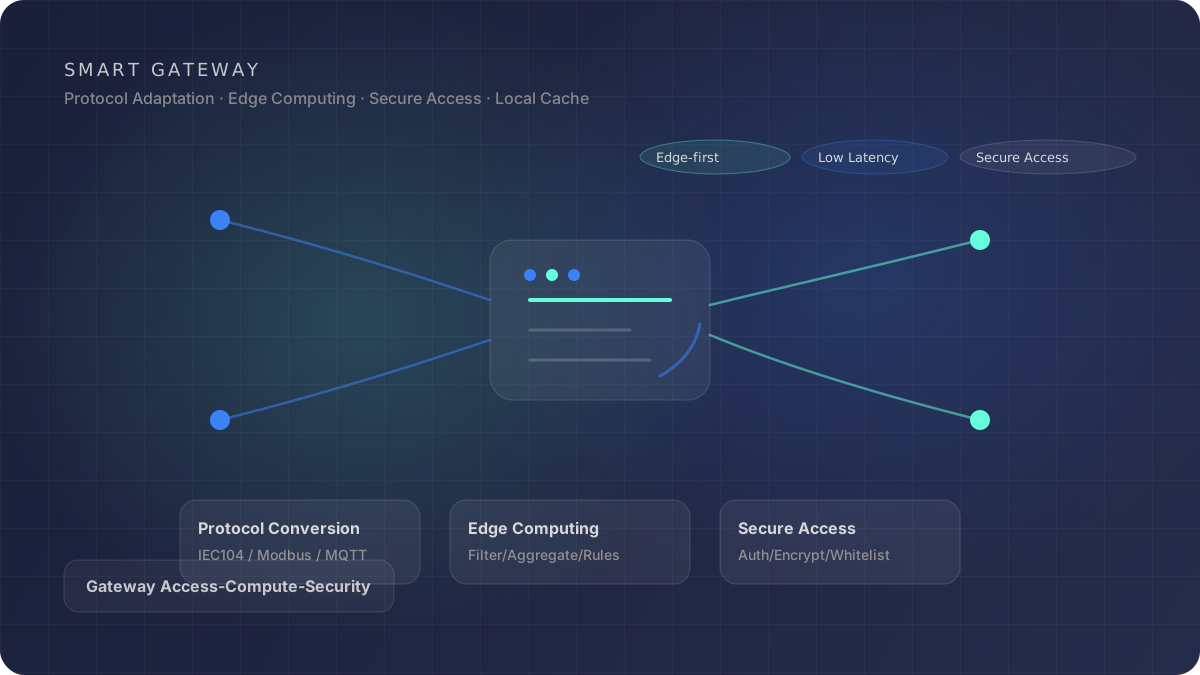
Smart Gateway

Core Capabilities

Designed for fast onboarding, stable operation and easy maintenance.

Multi-protocol connectivity

Support common power and industrial protocols to integrate devices and systems from different vendors.

Edge preprocessing

Clean, compress, aggregate and filter anomalies to reduce cloud load.

Local buffering & resume

Buffer when offline and automatically resume after recovery to ensure data integrity and service continuity.

Edge automation

Local rule triggers and control outputs—critical alarms arrive and are handled earlier.

Unified remote O&M

Remote configuration, upgrades, logs and health monitoring reduce repetitive on-site work.

Security & isolation

Network segmentation, access control and encrypted transport to meet power-grid security requirements.

Typical Use Cases

  • Device onboarding and status aggregation for substations and distribution rooms
  • On-site aggregation and forwarding for switchgear, RMUs, DTU/FTU
  • Edge aggregation and alarm automation for PV/storage
  • Unified multi-vendor device onboarding and fast go-live

Delivery

  • Gateway hardware and baseline configuration
  • On-site integration and commissioning support (optional)
  • Integration templates/protocol adaptation (per project)
  • O&M training and user manual